

វិចារណកថា
Explore the latest news, expert articles, and market outlooks to stay ahead of industry trends.
បន្ទប់ព័ត៌មាន

Government and Banjaran Asset Management Hold Productive Talks on New Collective Investment Scheme Fund
Phnom Penh, Cambodia - A significant meeting took place between His Excellency Su Sochet, the Director General of the Securities and Exchange Regulator of Cambodia (SERC), and representatives from Banjaran Asset Management (Cambodia) PLC. The delegation, led by H.E. Su Sochet, met to discuss the establishment and future prospects of Banjaran’s new Collective Investment Scheme (CIS) fund. This crucial dialogue aimed to align regulatory frameworks with the goals of the fund, ensuring its compliance with Cambodian financial regulations. The new CIS fund is expected to provide Cambodian investors with a broader range of investment options, allowing them access to international markets and enhanced financial growth opportunities. The discussions were highly productive, with both parties expressing optimism about the future of the fund and its potential to drive growth within Cambodia’s burgeoning financial services sector. The meeting also reinforced Banjaran Asset Management’s commitment to promoting robust investment solutions while adhering to the highest standards of governance and transparency. This marks a significant milestone for Banjaran Asset Management (Cambodia) PLC as it continues to collaborate closely with the SERC, bringing innovative investment opportunities to the Cambodian market. More Securities and Exchange Regulator of Cambodia

Investment Education Series related to Collective Investment Scheme (Part Three)
The Investment in Collective Investment Scheme In part two of the Investment Education Series, we discussed the needs and merits of investing as well as the benefits of investment diversification. The article concluded that an investment fund, or Collective Investment Scheme fund offers the best option for individuals to invest and grow their wealth steadily over time. A fund also helps to lower investment risk through diversification, all while keeping investing affordable to the public. In this article, we will share the real case study of the first Investment fund that was approved by the Securities and Exchange Regulator of Cambodia (SERC) on 15 November 2023, the BAMC Asia Equity Fund (BAEF). BAEF is managed by Banjaran Asset Management (Cambodia) PLC (BAMC), a SERC-licensed asset management company based in Cambodia. The fund lawyer is HBS Law and the fund auditor is Crowe (KH) Co., Ltd, both of which got the accreditation from the SERC. The fund trustee is Stronghold Trustee Co., Ltd which is also a SERC-licensed CIS trustee. In summary, in the ecosystem of the CIS, all players shall get a license, approval, or accreditation from the SERC. About BAMC Asia Equity Fund BAEF is a fund investing in a diversified portfolio of 30 or more companies listed on major stock exchanges across Asia Pacific Ex-Japan. The fund targets to provide the benefits of investing in Asia, which economists globally see as the premier growth region in the coming years. The fund’s tagline is “The Rise of Asia”. According to the disclosure documents, BAEF targets a return of 7% to 10% per annum over the medium to long term, yet this return is not guaranteed. The investment in fund is considered as a form of a regular savings plan. The invested amount can eventually be used for children's education, healthcare, to part fund the purchase of a house, or for retirement. To invest in the fund, the investor shall obtain an investor ID from the SERC first. However, for those who already have the investor ID, they do not need to re-apply for the investor ID. Below is a term sheet for the BAEF fund: Key Consideration Before Making Investment Decision Generally, fund managers make investments using basic approaches like the top-down approach and bottom-up approach. A top-down approach is when the fund manager looks at macro factors such as, economic cycles, inflation, interest rates, global trends, etc. The bottom-up approach is when the fund manager looks at the features of the individual securities that they invest in such as, the balance sheet, profit and loss statement, management, products, and services, etc. The BAEF adopts both approaches in making their investments. Bottom-up Approach: Sustainable Growth in the Long-term The fund manager will select companies that have proven sustainable business models and have proven track records. The fund manager will look at audited financial statements, valuation, and quality of management amongst other things. Top-down Approach: Why Invest in Asia? Stable Productive Population in the coming 10 to 20 years Asia has a large population base and a favorable demographics. It has a large segment of the younger population which will translate to a stable productive workforce over the next 10 to 20 years. This will result in higher income and higher consumption. These factors will help to drive the region’s economy and its businesses to grow. Relative to poor demographics from regions like the US and Europe, Asia is preferred. Strong Economic Growth In terms of economic growth, Asia is also growing faster and is bigger than the EU and North America. According to an IMF report dated Oct 2023, real GDP growth in 2023 is highest in Asia Pacific at 4.4% vs EU at 1% and North America at 2.1%. As % a share of the total world’s GDP, Asia Pacific share is 45.6%, the EU at 21.0% and North America at 18.7%. Benefits from the World’s Largest Free-Trade Agreement and Pro-Business Governments Asia’s economic growth will be further enhanced after 15 Asian countries recently signed a free-trade agreement known as the Regional Comprehensive Economic Partnership (RCEP), which will be the world’s largest free-trading bloc. The free-trade agreement should enhance trading activities and thus further drive GDP growth as a result. In its forecast, IMF projected Asia to remain as the strongest GDP growth region in 2028 at 3.9% vs EU at 1.6% and North America at 2.1%. Investment Education Series related to Collective Investment Scheme (Part Three) Asian Companies are Recognizable Globally Asia now has many homegrown listed companies which are recognizable globally. These companies are well-managed and have strong financials. They include companies like Singapore Airlines, Alibaba, Tencent, Samsung Electronics, TSMC, Grab, BYD and many others. Asia Markets Remain Cheap Despite Asia’s bigger population base and stronger economic growth, Asian stocks trade at much lower levels as compared to EU and US stocks based on valuation ratios like price-to-earnings, price-to-book value, and price-to-sales. These ratios are financial metrics that measure and analyze stock prices in unit terms and compare them with those of peers or competitors. The lower the financial ratio, typically the more attractive is the stock market or a particular stock. Furthermore, Asia ex-Japan accounts for 58% of the world’s population, and 48% of the world's economy, yet it accounts for only 12.42% of the investments made in the stock markets globally. BAMC views that the under-representation of Asian stock investments will have to be adjusted upwards eventually. Is it the Right Time to Invest Now? There is no right or wrong time to invest in the stock markets. Investing is a disciplined approach to set aside the savings and put them regularly into investments like an investment fund. Past market cycles show that each time markets fall, they will rebound. And when they rebound, they will set a new market high. In other words, stock markets tend to rise over the long term though in between, they may correct according to economic cycle or on non-economic-related events like war, pandemic, etc. In the current situation, stock markets in general have fallen since the beginning of 2022 on the back of several key events like the Russian-Ukraine war and the sharp increase in US interest rate. Is this an opportune time to invest? BAMC has analyzed the past market cycles and noted that after each significant event that had caused stocks to fall, they had rebounded sharply after riding out that event: Asian Financial Crisis in 1997 – the collapse of Asian currencies led by the Thai Baht and which spread to other Asian currencies, caused Asian markets to tumble. But they rebounded some 155% from the low in 1997 until 2000. Dot.com Bust 2000 and September 2001 – global markets fell when the US dot.com bubble went bust in 2000, and it was further made worse by the September 2001 bombing of the Twin Towers in the US. A couple of years later in 2003, Asian markets started to recover and moved higher. It rebounded some 360% since 2003. Global Financial Crisis in 2007 – the collapse of US banks Bear Stearns and Lehman Brothers in 2007 caused global markets to take a sharp tumble. The fall was rather short-lived and within less than two years, global markets recovered sharply by 236%. COVID-19 in 2020 – again global markets took a nosedive when the pandemic started. However decisive action by global central banks to provide funding to businesses affected by the pandemic caused the markets to again rebound very quickly. The markets fell but rebounded within a short span of six months by some 90%. Russia-Ukraine war and spike in inflation and interest rate hike in 2022 – markets have since fallen. Is it time to buy? An article from the Securities & Exchange Regulator of Cambodia (SERC)

Investment Education Series related to Collective Investment Scheme (Part Two)
Why Invest and the Importance of Investment Diversification Investment diversification across different asset classes would lower the risks compared to traditional investment portfolios. With the launch of the first Collective Investment Scheme (CIS), which was approved by the Securities and Exchange Regulator of Cambodia (SERC) recently, Cambodians now have an opportunity to further protect their investments. The CIS scheme now allows Cambodians to diversify their asset types into more legitimate investments across different countries which in turn lowers the risks. A further line of protection is with the investments being carried out only with fund managers licensed by SERC. The SERC recently approved Cambodia’s first SERC-approved CIS fund – the BAMC Asia Equity Fund, managed by Banjaran Asset Management Cambodia. Diversification of investment is not a new concept and is something that is propagated and recommended even by the world financial leaders. According to the world’s 6th richest man and famous investor Warren Buffet, “Never depend on a single income. Make an investment to create a second source”. There are many benefits to investing whereby it helps wealth creation with investors making more money. For Cambodians, it also paves the way for financial independence, eventually leading to them not worrying about their financial stability. It can also be a solid source of additional income to top up their regular income. Importantly, it could also serve as a protection against inflation, giving the investor the freedom of affordability when prices of goods increase. The positive wealth-creation effect of investing is illustrated in Figure 1 below: Investors, naturally would expect their assets to grow over time as they continue to maintain their investments. However, it is also important to note that all investments come with a certain amount of risk. The higher the return, the higher the risk. These risks can be moderated through a simple action of diversifying the investment in the regulated financial products. Currently, Cambodians tend to grow their wealth primarily through two forms of investments: bank fixed deposits and land-related investments. According to CEIC Data, in August 2023, Cambodia saw a record high of US$40.9 billion in total bank deposits. This was an increase from US$37 billion recorded a year ago. ❖ Other Types of Investment There are many investment options available for investors, ranging from lower-risk investments like bank deposits and investment-grade bonds to the extremely high-risk investments like private debt and private equities where investors may potentially lose all their invested capital. ❖ Investment Diversification Investment diversification is the process of spreading your investments across different asset classes (bank deposits, stocks, bonds, real estate, etc), across different countries (HK/China, US, Japan, Singapore, Thailand, etc), and across different industry sectors (banking, consumer, technology, property, etc). The main objective is to spread the risk such that if one investment goes bad, it should not affect the overall investment. When investments are diversified, the risk is lower. In an equities collective investment scheme fund, for example, the risk of investing in stocks can be reduced through diversification. This is done by creating a basket of stocks (known as a portfolio) comprising of 30 different stocks. The diversification benefits include not just from an increase in the number of stocks invested, but also by investing in different countries and across different industry sectors such as banking, property, consumer, telecoms, technology, etc. Through diversification by adding more stocks to a fund, the risk is greatly reduced. The illustration below shows the diversification benefit-risk reduces as more stocks are added to the portfolio: One point to note is that while adding more stocks to a portfolio will reduce risk, it will come to a point where the residual risk cannot be further reduced as more stocks are added. This residual risk is known as the market risk (indicated by * in Figure 3), which cannot be diversified away. An example of market risk is when a major war breaks out, or a global pandemic that goes out of control, on a scale that is worse than COVID-19. For an individual, it is troublesome to practice investment diversification. Firstly, the investment amount may be too small to diversify into different asset classes, or to buy too many stocks. Secondly, transaction costs may be high and will affect the investment return as a result. Thirdly, the investor may not have time or knowledge to track the different investments and this may lead to taking no action as a result. And lastly, investors may lack the discipline to maintain proper investments. Likewise, Cambodians generally should diversify their asset types into more legitimate investments. A good diversification would be to invest some in fixed deposits, land-related investments, and collective investment scheme funds. Collective Investment Scheme (CIS) fund collects monies from different investors and pools them together for investment purposes. Each investor retains ownership and control of his own units in the fund. The fund then invests in assets like stocks, bonds, real estate, etc. For an equities CIS fund, for example, a professional fund manager licensed by the SERC does the investment work. Investors can choose when to invest or exit the fund. Funds come with different investment strategies and objectives and appeal to different investors with different risk appetites. Investing in a CIS fund should offer investors an easy way to meet their investment and investment diversification objectives. An investment fund offers multiple benefits. This includes it being professionally managed by a SERC-licensed fund manager and the fund is separately approved by the SERC for sale to the investing public. It may offer diversification benefits as some CIS funds will invest in a diversified portfolio of stocks across different countries and different industry sectors The initial investment amount can be set at an affordable level, for example as low as US$500. With this small amount of investment, an investor can own units in a portfolio of approximately 30 stocks or more. It also gives Investors the right to buy and sell the fund on a daily basis with the pricing of the fund being transparent and published daily in the local media. Investing should generate a reasonable, positive return with a manageable degree of risk. Individuals should generally invest in products that are regulated by the SERC, and managed by SERC-licensed fund managers. To be able to invest in a fund unit, the investor shall obtain the Investor Identification Number (ID) from the SERC first. Investors should also practice investment diversification to minimize investment risk. CIS fund offers investors the ease of investing, and also provides the other benefits from investment including diversification. An article from the Securities & Exchange Regulator of Cambodia (SERC)
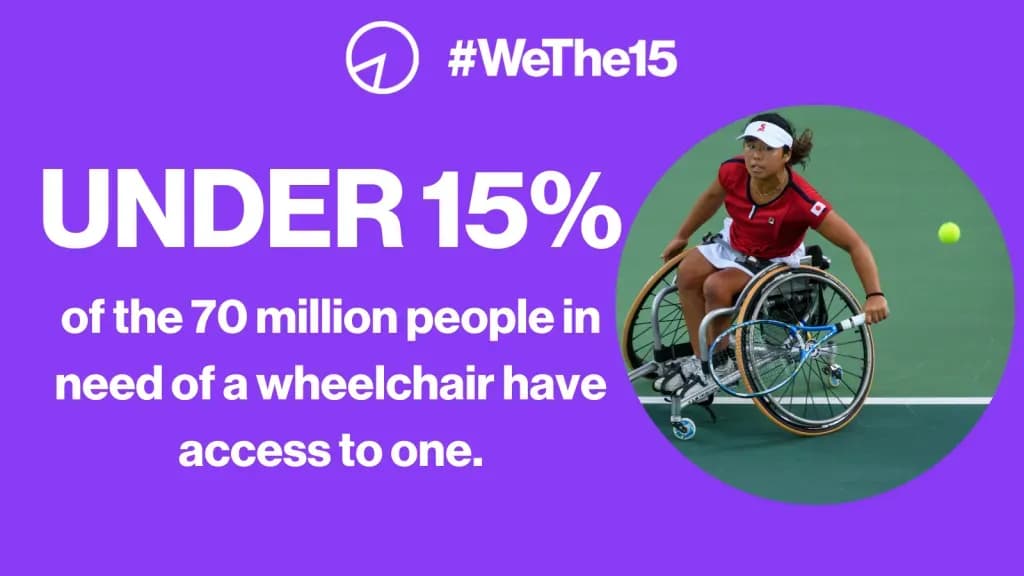
Joins Global "#WeThe15" Movement at National Centre of Disabled
Phnom Penh, Cambodia – Banjaran Asset Management (Cambodia) PLC. participated in the global "#WeThe15" event held at the National Centre of Disabled. This event, part of the worldwide campaign to represent the 1.2 billion people living with disabilities, aims to advocate for their inclusion, rights, and visibility. As part of the "#WeThe15" movement, Banjaran Asset Management (Cambodia) PLC stood alongside other organizations in promoting greater awareness and support for persons with disabilities. The event featured a series of engaging activities, discussions, and initiatives focused on driving equal opportunities and improving accessibility for those with disabilities. Banjaran Asset Management (Cambodia) PLC's involvement in this global initiative highlights its dedication to corporate social responsibility, fostering an inclusive community, and supporting efforts toward equality and empowerment. Through initiatives like "#WeThe15," the company remains committed to making a positive impact both locally and globally.

Press Conference - Cambodia First Collective Investment Scheme Fund
Press Release Banjaran Asset Management (Cambodia) PLC (“BAMC”) has successfully obtained approval from the Securities and Exchange Regulator of Cambodia (“SERC”) to launch the BAMC Asia Equity Fund (“BAEF”) in the Kingdom of Cambodia. BAEF is the first retail fund to launch for sale in the Kingdom which the public will be able to invest in. BAEF is an investment fund investing in a diversified portfolio of companies listed on major stock exchanges across Asia Pacific Ex-Japan. The fund targets to provide the benefits of investing in Asia, which economists globally see as the premier growth region in the coming years. The fund’s tagline is “The Rise of Asia”. Being the first SERC-approved retail fund to launch in Cambodia, BAMC will give Cambodian investors, who to date have narrowly relied on bank deposits to grow their wealth, an opportunity to diversify their investments. In addition, Cambodians would no longer need to travel to foreign financial centers to access investment opportunities outside the Kingdom. BAEF is the first of a series of funds that BAMC plans to bring to the investing public in Cambodia. To make the fund accessible to all investors, BAMC has set the minimum investment amount at just US$500. BAMC is the fund manager of BAEF with Banjaran Asset Management Pte Ltd (“BAMPL”) of Singapore as the investment advisor. Stronghold Trustee Co., Ltd (“ST”) is the trustee of the fund. Her Excellency Chan Theany (“HE Theany”), Chairwoman of BAMC said: “We are honored and happy to be the first fund management company in Cambodia to successfully launch a SERC-approved public collective investment fund. I am proud to report that in the process of obtaining the various licenses and approvals, we have trained a team of local Cambodians to take on various roles in the areas of asset management. For the launch of BAEF, we have brought in international fund management expertise and its best governance practices. We hope this will set a high standard for the asset management industry going forward.” Mr. Aaron Ng (“Aaron”), CEO of BAMPL said: “BAMPL is proud to be the investment advisor to BAEF, Cambodia’s first approved public investment fund. We have extended our experiences, international practices, and best governance practices to BAMC. We offer our best wishes to BAMC on this launch.” About BAMC Asia Equity Fund (“BAEF”) The BAEF is an investment fund that invests in stocks listed in major stock exchanges in Asia Pacific Ex-Japan. It aims to deliver an expected return of 7-10%* per annum over the medium to long term. The Fund is expected to be diversified with at least 30 stocks across Asia (eg. Singapore, Hong Kong/China, Australia, Thailand, Malaysia, Indonesia, Philippines, etc.) and across various sectors (eg. Banking, Property, Industrials, Consumer, Telecoms, Technology, etc.). The Fund is domiciled in the Kingdom of Cambodia and is USD-denominated. The Fund will accept subscriptions and redemptions daily and the daily unit price of the Fund will be available on various media channels. *- Investment return is not guaranteed. About Banjaran Asset Management (Cambodia) PLC (“BAMC”) BAMC was incorporated in the Kingdom of Cambodia in 2022 and holds a fund management license issued by the SERC to establish and manage a public funds of collective investment scheme. BAMC is a joint venture between Banjaran Holdings Pte Ltd from Singapore, Best Magnet Capital Co., Ltd, and Primo Plus Co., Ltd. Banjaran Holdings and BAMPL are related companies. About Stronghold Trustee Co., Ltd (“ST”) ST is the first Full-Licensed Trustee licensed by the Securities and Exchange Regulator of Cambodia and registered with the Trust Regulator. It specializes in trust services, including Collective Investment Scheme and Personal and Commercial trusts tailored to clients’ needs. ST is part of the Stronghold Group of Companies and has its roots in Taiwan. About Banjaran Asset Management Pte Ltd (“BAMPL”) BAMPL was incorporated in Singapore in 2014 and currently holds a Capital Market Services license in fund management issued by the Monetary Authority of Singapore. BAMPL’s main business activities are in investment management and its funds are distributed through private banks and investment banks across Asia and the UK. BAMPL is also a leading provider of multifamily office services in Singapore. BAMPL’s assets under management are approximately US$ 5 billion (as of 30 June 2023) in a variety of asset classes. These include private and listed equities, private and listed debts, alternative investments, ESG-focused investments, and real estate investments. More News EAC News Kampuchea Thmey Fresh News Asia TNAOT Jia Hua Daily Cambodia Express News Khmer Times Phnom Penh Post Sabay News Kiri Post Securities and Exchange Regulator of Cambodia (SERC) Cambodia Investment Review BTV News
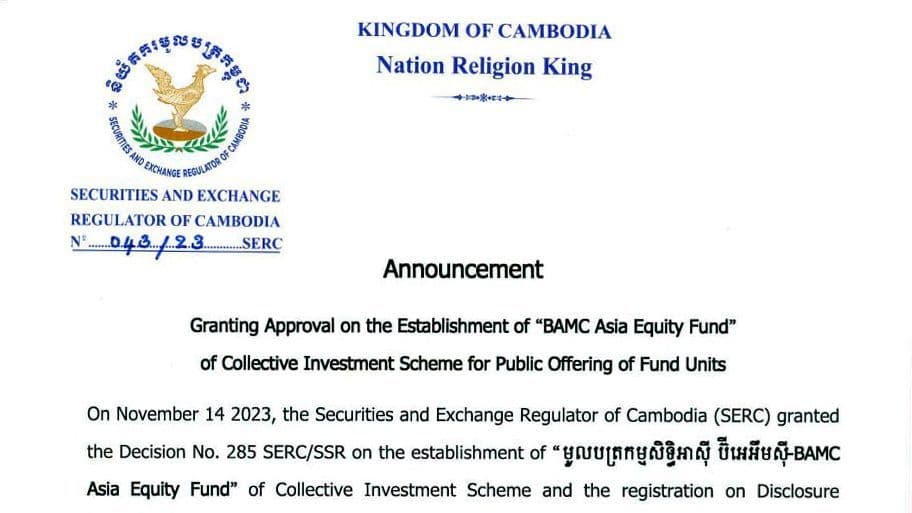
SERC Approves BAMC Asia Equity Fund for Public Offering
Phnom Penh, Cambodia – The Securities and Exchange Regulator of Cambodia (SERC) has officially granted Decision No. 285 SERC/SSR for the establishment of the “មូលបត្រកម្មសិទ្ធិអាស៊ី ប៊ីអេអឹមស៊ី - BAMC Asia Equity Fund” as part of the Collective Investment Scheme. This landmark decision also includes the registration of the Disclosure Document (Prospectus) for the public offering of fund units managed by Banjaran Asset Management (Cambodia) Plc. The BAMC Asia Equity Fund marks a significant advancement in Cambodia's financial landscape, providing local and international investors with diverse investment opportunities. This fund is designed to enhance access to capital markets and promote economic growth in the region. Banjaran Asset Management (Cambodia) Plc is committed to upholding the highest standards of fund management and governance practices. With the approval of the BAMC Asia Equity Fund, the company aims to contribute positively to the development of Cambodia’s capital markets and provide investors with innovative investment solutions. The launch of the BAMC Asia Equity Fund is expected to set new benchmarks for collective investment schemes in the Kingdom, fostering a more vibrant and inclusive financial services sector. Further updates regarding the fund's public offering will be announced soon.

Investment Education Series related to Collective Investment Scheme (Part One)
Investing in Legitimate Investment Products According to published figures by the World Bank, Cambodia's GDP per capita has risen from US$783 (2010) to US$1,625 (2021). Statista.com projected that its GDP will continue to grow to approximately US$2,656 by 2028. The growth in the middle income and increase in wealth of the average Cambodian will naturally bring about the need for investing. However, recently we have also seen a spike in cases of reported fraudulent and failed investment schemes, as well as some which are outright scams. When investing, investors are traditionally enticed by high returns and a sense of familiarity. Very often they ignore what is perhaps the most important factor when investing, which are the risk factors. Risk comes in many forms, to name a few: Counterparty Risk Market Risk Currency Risk Liquidity Risk Regulatory Risk Specific Risk Environmental Risk Bankruptcy Risk Operational Risk Based on past data, it is evident that there is a direct relationship between risk and return. The higher the return from a particular investment, the risk becomes higher. We can illustrate this in a simple graph. Generally, to mitigate the risk, investments should be made on or above the line. Furthermore, investors should select legitimate investment products. ❖ Legitimate investment products (Regulated) When investing, investors should consider whether the investment scheme is regulated, unregulated, or an outright scam. Regulated investment products are generally subject to onerous supervision by the country’s regulators. This makes regulated investment products safer choices compared to the others. A regulated investment product will generally have these features: Approval from the regulator Managed by a licensed fund manager Proper legal documentation and disclosures and will normally be audited by an audit firm accredited by the regulator. Therefore, the risk of a regulated investment scheme being a fraud is very low. ❖ The update of the Cambodia Collective Investment Scheme Market Acknowledging the potential of the collective investment scheme market for economic growth, the Securities and Exchange Regulator of Cambodia (SERC), a sole regulator to regulate, supervise, and develop the securities market in Cambodia has developed the infrastructure to launch this market through the adoption of the Prakas to regulate this market. As a result, on May 29, 2018, SERC adopted the Prakas on “Licensing and Supervision of Collective Investment Scheme Business” to allow companies to apply for a license or approval from the SERC to conduct the Collective Investment Scheme Business. As of Q3 2023, SERC has provided license/approval to 16 fund management companies, 8 trustees, 5 fund distribution companies, and 3 fund administrators. In addition, on July 20, 2023, SERC also adopted the Prakas on “The Issuance of Fund Unit of Collective Investment Scheme”. This Prakas determines the condition and requirement to issue fund units of the collective investment scheme and the post-issuance operation to ensure the orderliness, accountability, and transparency in the market and, most importantly to protect all market stakeholders including investors. ❖ Unregulated Investment Products Unregulated investment schemes are generally operating companies offering high returns and are only governed by the basic corporate regulations. Scams and unregulated investment schemes are often difficult to differentiate. These investment schemes generally have the following features: The promise of unusually high returns (too good to be true because the risk may be extremely high), Poor documentation (hidden risks and hidden costs are not disclosed), Managed by a small team of individuals (usually with exaggerated backgrounds), No proper third-party verification (not audited – all done by one company). Most importantly, there are no regulators to supervise the legitimacy of the investment schemes. ❖ Scams or Fraudulent Investment Schemes These are recent cases of unregulated investment schemes that have gone bad in Cambodia: The International Forex Trading case of 2019, in which the scheme was operated by a small group of individuals making promises of very high returns. There were no checks and balances and the company was in charge of both making the investment as well as issuing cheques to investors. Such unregulated companies, when unchecked by an independent third party can make false and exaggerated claims. In the Empire Big Capital Limited and Investment Consultant Association case of 2017, again this scheme was operated by a small group of individuals making promises of very high returns (10% per month). Similar to the previous case, there were no checks and balances, the company basically did everything internally. There were also reports of land investment schemes that have turned sour and were alleged to be fraudulent. Some of these operators have been arrested and charged, and some jailed. The alleged land investment scheme always promised high returns. There is a lack of transparency in how the funds were invested and with regard to the progress of the projects and their cashflows. It is important to note that there is a difference between an investment scheme going bad and it being an investment scam. All investments have to take risks to generate returns. There are many examples of investments going bad due to poor market conditions and other reasons. Scams happen when there is no real intent to channel money collected from investors into the stated investment. Instead, profits are fictitiously generated by using money from new investors to pay previous investors. This is known as a Ponzi scheme. Scam operators are in all instances not approved by regulators. ❖ Conclusion In seeking legitimate investments, investors should consider the following: Is the company regulated by the relevant authorities? Is the product approved by the relevant authorities? Does the investment reasonably justify the return that is promised? Does the collective investment scheme have basic checks and balances, like independent lawyers, auditors, and other professionals? Lastly, trust your instincts. If an investment sounds too good to be true, you should investigate further and ask more questions. In selecting a legitimate investment that fits your risk profile, the investment should diversify your risk and at the same time help you grow your wealth over time. An article from the Securities & Exchange Regulator of Cambodia (SERC)

Banjaran Asset Management Submits BAMC Asia Equity Fund for Collective Investment Scheme Approval to SERC
Phnom Penh, Cambodia – Banjaran Asset Management (Cambodia) Plc. has taken a significant step forward in the financial sector by submitting the application for its BAMC Asia Equity Fund for fund unit offering approval. The submission falls under Cambodia's Collective Investment Scheme (CIS) regulatory framework, reflecting the company's commitment to providing robust investment opportunities in the region. The inspection of the application was conducted by Her Excellency Thay Sokphalline, Director of the Securities Issuance Department, along with a team of officials from the Securities and Exchange Regulator of Cambodia (SERC). The comprehensive review marks an important milestone for the BAMC Asia Equity Fund, which aims to broaden access to diverse investment portfolios, catering to the growing demand for equity investment solutions in Asia. The BAMC Asia Equity Fund represents a pioneering effort in Cambodia’s capital market landscape. Banjaran Asset Management remains confident that this offering will contribute to the country’s economic growth by attracting both domestic and international investors. With a strategic focus on high-growth sectors across the Asia region, the fund is poised to deliver long-term returns for investors while strengthening Cambodia’s position in the global financial market. Banjaran Asset Management (Cambodia) Plc. continues to work closely with regulatory bodies to ensure compliance with all legal and financial guidelines. Pending approval, the BAMC Asia Equity Fund will be the first of its kind in the Cambodian market, marking a significant achievement in the country's financial sector development. For further updates and details, please stay tuned for official announcements from Banjaran Asset Management and the Securities and Exchange Regulator of Cambodia (SERC).
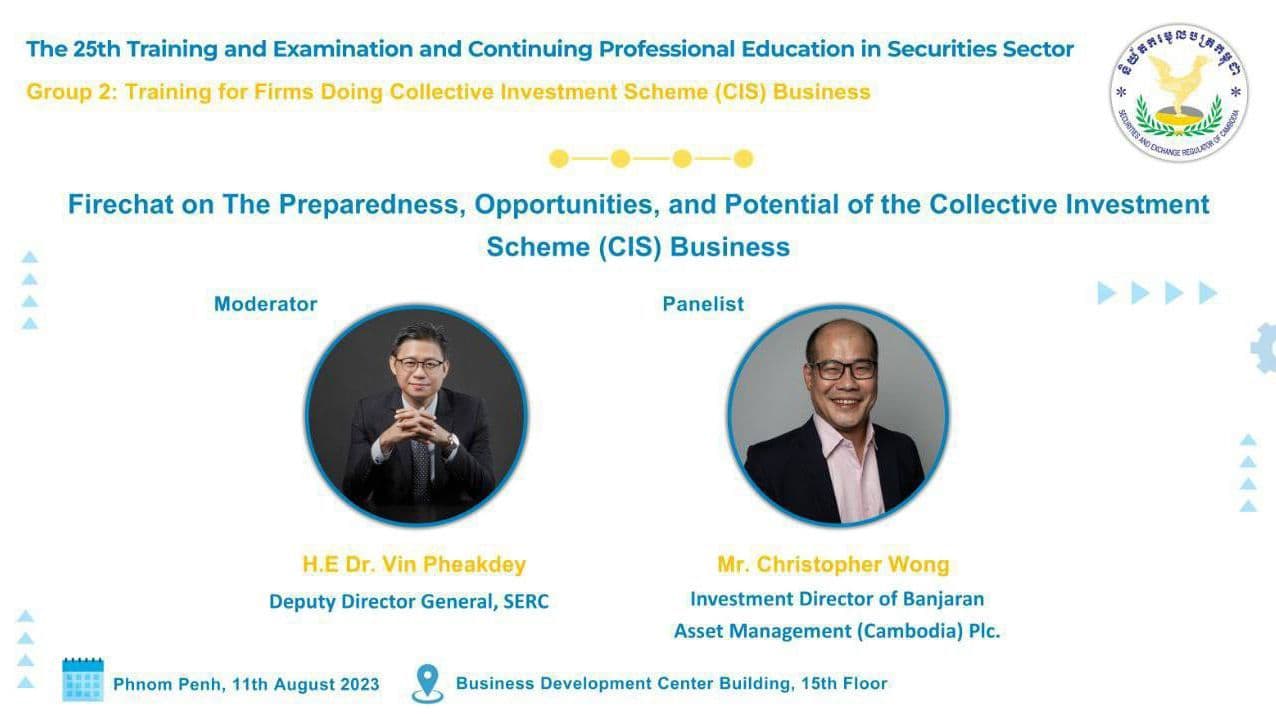
Firechat on The Preparedness, Opportunities, and Potential of the Collective Investment Scheme (CIS) Business
Phnom Penh, Cambodia – Mr. Christopher Wong, Investment Director of Banjaran Asset Management (Cambodia) PLC, participated in a dynamic discussion titled “Firechat on The Preparedness, Opportunities, and Potential of the Collective Investment Scheme (CIS).” The event was moderated by H.E. Dr. Vin Pheakdey, Deputy Director General of the Securities and Exchange Regulator of Cambodia (SERC). The discussion focused on the evolving landscape of collective investment schemes in Cambodia, emphasizing the importance of regulatory preparedness and the potential for economic growth through these investment vehicles. Wong shared his expertise on the opportunities that CIS presents for both local and international investors, highlighting its role in enhancing capital access and promoting financial inclusion in the country. The event also provided a platform for industry stakeholders to engage in dialogue about the challenges and opportunities within the investment sector. Wong's insights contributed to a deeper understanding of how collective investment schemes can be leveraged to strengthen Cambodia's financial markets. As the country continues to develop its capital markets, such discussions are crucial for fostering collaboration among regulators, investors, and industry leaders. Banjaran Asset Management (Cambodia) remains committed to participating in initiatives that promote a robust investment environment and advance the nation’s financial services sector. Firechat on The Preparedness, Opportunities, and Potential of the Collective Investment Scheme (CIS) Business.
ទស្សនៈទីផ្សារ

2024 October Market Outlook: Hong Kong and China Stocks Await Policy Boost as AI Growth Persists in the US
Since the initial surge in the Hong Kong and Chinese stock market, significant profit taking has followed. Despite this, we maintain our view that company valuations in the region remains attractive. The main event that we are monitoring is towards the end of this month, where China holds their Politburo Standing Committee. We expect major stimulus measures to be announced given the state of their economy, and this should result in a positive impact to stock valuations. In the absence of strong stimulus measures, we will be reassessing our view on the region. We remain confident that investments in artificial intelligence (“AI”) applications will remain strong through 2025, driven by the industry's continued high-growth potential. While sales momentum has moderated, we believe this cycle has several more quarters of growth ahead. As a result, we believe that modest selloffs in the US technology sector are potentially attractive entry points.

2024 September Market Outlook: Tech Stocks Face Headwinds as AI Valuations Come Under Scrutiny
Since the last newsletter, technology stocks continued to underperform as investors began to question the premium valuations that these companies command since the start of the artificial intelligence (“AI”) narrative. There is no doubt that AI will result in long-term productivity gains as more companies begin to announce standalone AI products. Additionally, continued improvements in AI hardware will likely accelerate development going forward. As we assess the current investment landscape, we anticipate the road forward for AI-related opportunities to be less smooth than the past year as investors increasingly scrutinize the potential for these AI investments and applications to deliver solid returns. We believe that the first to see widespread AI adoption would be in areas that provide support in pattern recognition and personal assistance. These applications, while not entirely new, have progressed significantly over the past year. To illustrate, Salesforce has recently announced Agent Force, a client servicing bot that is easily customizable for different industry applications. Compared to older chatbots, early adopters of Agent Force have seen a 40% improvement in customer query resolution. In healthcare, doctors are also increasingly using AI to assist with effective diagnosis and drug development. We are well positioned to benefit from increasing AI adoption over the long-term on this front. Where we are looking to gain additional exposure is in AI-related hardware. We are tracking several data center equipment and power management companies. However, these sectors in general are trading at a high premium and are already well-invested. We believe we should take a more considered approach prior to initiating a significant position given the high valuations. The AI landscape is undoubtedly changing very quickly, and we will be flexible on our positions depending on the developments that unfold going forward.

2024 August Market Outlook: Yen Carry Trade Unwinds, Sparking Global Market Shifts
Early in August, equity markets experienced a sudden spike in volatility, where volatility reached levels unseen since the COVID-19 crash. This was caused by a significant unwinding of the Yen carry trade. The unwinding was triggered after the Bank of Japan (“BOJ”) unexpectedly raised interest rates, where a sharp appreciation in the Japanese Yen followed. Traders who borrowed Yen cheaply then had to sell off their investments to pay back their borrowings. The situation worsened when weaker-than-expected US employment data caused the greenback to depreciate further against the Yen. Shortly after the sharp market decline, the BOJ has given comfort to the public that they will not hike interest rates further while financial markets are unstable. Thus, we are of the opinion that as of now, the carry trade should not cause further volatility. We are cautiously optimistic about the market consolidation. The reason for the caution is due to the still high valuation of the broad US equity market despite increasingly slowing fundamentals and economic data. We will continue to watch near-term trends given that a broad recovery in equity markets normally results in bullish short-term sentiment.

2024 July, Market Outlook: Mixed Signals from China and Cautious Optimism in the US
China’s economic landscape continues to be buoyed by its manufacturing sector, while consumer spending remains notably sluggish. Recent data reveals that retail sales growth has fallen short of expectations, with the latest Q2 Gross Domestic Product (GDP) reading showing a deceleration to just 4.7% year-on-year. However, there are encouraging signs in the property market; easing measures on homebuying has resulted in a significant uptick in secondary property sales in tier-one cities, which jumped by double digits. While this early data is promising, we remain cautious. Our previous observations indicate that any increase in home sales following the significant relaxation of restrictions in 2023 was short-lived. Therefore, we will closely monitor the outcomes of the upcoming Third Plenary Session, which will shed light on the policies that will shape China’s economic future. In the United States, we maintain a cautious stance regarding the medium-term economic outlook. The deceleration in growth and rising unemployment trends have yet to raise alarms among investors, primarily due to the robust inflow of investments related to artificial intelligence. Over the long term, we believe that fiscal dominance will be a critical factor, as the Congressional Budget Office projects that debt-to-GDP ratios could soar from around 120% today to 200% within the next 30 years. This projection raises valid concerns about the sustainability of the US economy. However, we posit that the current status quo could persist longer than anticipated. History shows that attempts to time market peaks often lead to substantial opportunity costs. Thus, we will continue to invest in US firms while remaining vigilant about potential de-dollarization and long-term debt risks. Following recent testimonies from the Federal Reserve regarding their readiness to lower interest rates, combined with market expectations of a potential Donald Trump victory in the upcoming presidential election, we have witnessed a noticeable rotation into smaller-capitalization stocks. These stocks have underperformed the Standard & Poor’s 500 Index since the COVID-19 pandemic heavily impacted their operations. Market sentiment seems to be favoring a "no landing" scenario, where small businesses could benefit more from lower borrowing costs and increased fiscal spending compared to larger firms. However, we approach this sector with caution, particularly concerning smaller companies that have significant debt exposure, given our apprehensions about a global slowdown in demand. In conclusion, while China shows signs of resilience through its manufacturing sector and initial recoveries in property sales, the broader economic outlook remains mixed, requiring careful observation of forthcoming policy changes. Meanwhile, the US market, bolstered by AI investments and potential shifts in fiscal policy, is experiencing volatility as investors reassess their strategies in light of evolving economic indicators. As we navigate these complexities, our focus remains on identifying solid investment opportunities while balancing risks in an uncertain environment.

2024 June, Market Outlook: Semiconductor Surge, Fed Caution, and AI's Future Potential
The equity markets have continued to reach new highs, largely driven by the exceptional outperformance of semiconductor stocks. This concentrated movement suggests that investors are placing heavy bets on a few sectors, which may indicate underlying caution about the broader economy. While the semiconductor sector's growth has been impressive, this narrow market rally could be vulnerable to shifts in sentiment, making it essential for investors to stay vigilant. On the macroeconomic front, the US Federal Reserve has remained cautious, withholding any strong indication of interest rate cuts in the near term. Citing robust employment numbers and persistently high inflation, the Fed has expressed that it needs to see more data before making any moves. As businesses and consumers have so far shown resilience, many market analysts have pushed back their expectations of a potential recession. However, there are signs of softening in the labor market, with the US unemployment rate gradually climbing to 4%, up from a low of 3.4% in 2023. This could be a precursor to broader economic weakness, aligning with our view that the Fed may have room for at least one interest rate cut later this year. China’s market performance, by contrast, has started to lag after the initial wave of optimism following the government’s policy interventions aimed at stabilizing the property market. Profit-taking has emerged as a natural response to the sharp upward momentum in Chinese equities earlier in the year. While market participants are now in a holding pattern, awaiting further updates on the property industry, we maintain the view that China’s real estate challenges are unlikely to result in systemic risk. The Chinese government has shown a clear commitment to managing the situation and is expected to introduce further targeted measures as needed. In the technology sector, we are particularly optimistic about the long-term productivity gains that could arise from AI applications. For example, a recent study found that software developers using Microsoft's GitHub CoPilot—an AI-powered coding assistant—completed tasks up to 56% faster than those without the tool. This significant efficiency boost highlights the transformative potential of AI in the workplace. Expectations for AI are sky-high, with investment in hyperscalers projected to grow at an annual rate of at least 20% through 2030. While AI-driven automation in areas such as customer service, email summarization, and image generation is expected to yield cost savings, we believe the next major economic leap will come from advancements toward Artificial General Intelligence (AGI). Current generative AI models have made substantial progress in recent years but are still limited by their inability to adapt effectively when faced with queries outside their training data. The evolution toward AGI would address this limitation, enabling AI to perform a broader range of tasks with greater accuracy and versatility. Additionally, consumer applications of AI are somewhat constrained at present, as mobile hardware lacks the processing power needed to run AI-driven tasks efficiently. However, the sustained investment in AI technologies is already leading to rapid improvements, and we continue to monitor developments for potential investment opportunities as companies push the boundaries of innovation and find new ways to monetize AI advancements. In summary, while semiconductor stocks have driven much of the equity market gains in 2024, a cautious stance is warranted due to the concentration of market activity. The Fed's hesitance to cut rates amid a weakening labor market adds another layer of complexity. Meanwhile, China's property market stabilization efforts are ongoing, and AI’s long-term promise continues to excite, but its full potential may take years to materialize. As we navigate these shifting dynamics, we remain focused on identifying selective opportunities across sectors and regions.

2024 May, Market Outlook: Navigating Global Volatility and Strategic Opportunities
Global equity markets have staged a strong recovery from April's decline, buoyed by cooling US economic data and a wave of significant share buyback programs. We anticipate that this erratic market behavior will persist until there's more certainty regarding the timing of interest rate cuts, as investors eagerly respond to any hints of monetary easing. With the US elections approaching, we also expect heightened volatility as uncertainty around future government policies grows. In China, the government has taken direct action to restore confidence in the property sector. Restrictions on home-buying have been fully lifted in major cities like Xi’an, Hangzhou, and Chengdu, with further easing measures introduced elsewhere. More notably, the administration has launched a 300 billion RMB facility for local governments to acquire excess property inventory and convert it into affordable housing. This initiative has been well-received by market participants, leading to sharp price appreciation in China’s equity markets. However, we believe that for the facility to have a meaningful impact on the broader property sector, it will likely need to be expanded further. If these efforts are scaled up, property prices could stabilize, and consumer confidence may return. In addition, the Chinese government’s push for large-scale equipment renewals and trade-ins of durable consumer goods is aimed at boosting private consumption growth over the next few years. Other recent measures, such as removing mortgage rate floors and lowering downpayment rates, further signal China's commitment to supporting its economy. As Q1 earnings season concludes, we’ve observed mixed results from major US corporations. Consumer discretionary firms report slowing spending and a more selective consumer base, while companies with international exposure have commented on a slower-than-expected recovery from Chinese consumers. In contrast, US technology firms have maintained robust growth, particularly those benefiting from AI adoption. In China, a similar trend emerges: technology firms are expanding, while consumer spending remains tepid in most sectors. However, China's consumer base is on an upward trajectory, whereas the US is seeing a slowdown. Given the potential turning points in major global economies, we plan to be highly selective in both US and Chinese markets based on our current exposures. While economic data in Japan remains weak, we remain optimistic about the ongoing corporate governance reforms, which we believe will drive improved shareholder returns over the long term. Looking ahead, we remain focused on navigating these uncertainties and positioning ourselves to take advantage of selective opportunities in the evolving market landscape.